Scar Tissue After Surgery

Scar Tissue After Surgery

Scar tissue is a natural part of the body’s healing mechanism. When any part of the body receives an injury, it will work quickly to heal the injury. This repair process creates scar tissue. Scar tissue acts differently than normal tissue, and it may contain damaged cells, which is why it looks different than the tissue around it. Although most people think scars only affect the skin’s surface, scar tissue can also occur on any tissue in the body, including internal organs.

Although it is part of the healing process, scar tissue may end up causing problems, especially when it leads to adhesions. For most people, scar tissue causes most problems on the skin itself by leaving a life-long reminder of the surgery. By knowing what to expect after surgery, you can minimize the appearance of scars and other potential complications, including helping to reduce the time a scar takes to fade.

Scar Tissue on the Skin

Surgery typically includes an incision of the skin, usually extending through all the layers of the skin. Surgeons try to minimize the size of their incisions to reduce the amount of scar tissue that develops. The main factors determining the amount of scarring after surgery, beyond the skill level of the doctor, are age, race, genetic makeup, the size and depth of the incision, and the extent of the surgery. Initially, scar tissue will be pink, red or purple, due to the injury to the blood vessels and the inflammatory response that is part of the body’s reaction to any injury.

Over time, as the skin heals, scarring will fade and become closer to your skin’s natural pigmentation. However, many scars also turn white due to damage to the cells that control pigmentation. After surgery, the incision area will be sensitive and weaker than normal skin, so you should rest and avoid any movement or stress that could place too much stress on the healing incision.

What are Adhesions?

Although most people only focus on scar tissue after surgery on the skin, surgery can also cause internal scar tissue called adhesions. An adhesion is scar tissue that binds together two pieces of internal tissue or organs, even if they are not supposed to be connected. This distorts the normal internal anatomy, which can then cause problems.

The most common areas of adhesions are in the abdomen, heart and the pelvic area. Almost 93 percent of patients who undergo any type of pelvic or abdominal surgery end up with adhesions. Adhesions can be thin sheets of the tissue that may look similar to plastic wrap or strong, fibrous bands that can cause serious complications. Most adhesions are harmless and will go away on their own, but some adhesions can lead to complications and further problems.

How to Minimize the Appearance of Scars

Although doctors do everything they can to minimize any scar tissue, there are some actions you can take to prevent or minimize their appearance. Scars develop as part of the body’s natural healing processes. The faster and more efficiently the body heals, the reduced risk of scarring, or the faster it will take for the scar to go away. By avoiding smoking and drinking, eating a healthy diet, and staying hydrated, you will provide the body with the best foundation to heal properly. You should also practice proper wound care, which includes keeping your fresh scar covered and out of the sun, as well as following all your doctor’s instructions. It takes time for the skin to fully heal and for the scar to mature and look its best, often up to a year or even two. By taking appropriate care of your fresh scar and yourself, and using a good scar minimizing cream once the skin has healed, you’ll give your scar the best chance of fading.

Do you have a question about your scars? Leave a comment and we’ll be happy to help.

Subscribe to Scars and Spots to get our posts delivered directly to your inbox!

Share and Enjoy

  • Facebook
  • Twitter
  • Delicious
  • LinkedIn
  • StumbleUpon
  • Add to favorites
  • Email
  • RSS
Neck Scar Treatment Before and After

Neck Scar Treatment Before and After

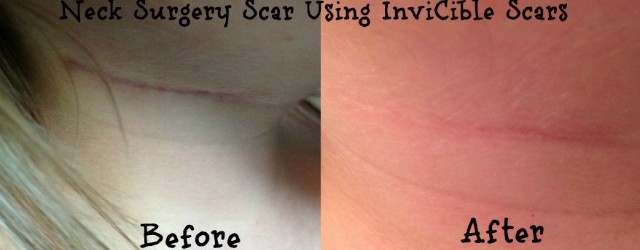
We absolutely love to hear from our customers that InviCible Scars WORKS. Our scar treatment covers a wide range of scars and isn’t just limited to acne scars or fading hyperpigmentation. Below is a testimonial from our customer, Stephanie in New Hampshire, who had a scar from neck surgery:

Neck Surgery Scar Before & After InviCible Scars Treatment

I love InviCible! It has made a very distinct surgery scar on my neck look just like one of the lines in my neck! - Stephanie, NH

We love making our customers happy and fading the scar, but not their confidence! We have plenty more scar treatment before and after photos, as well as InviCible Scars reviews that you can read.

Have you tried InviCible Scars risk-free yet?

Do you have a question about your scars? Leave a comment and we’ll be happy to answer.

Subscribe to Scars and Spots to get our posts delivered directly to your inbox!
Share and Enjoy

  • Facebook
  • Twitter
  • Delicious
  • LinkedIn
  • StumbleUpon
  • Add to favorites
  • Email
  • RSS
How to Fade Cleft Lip Scars

How to Fade Cleft Lip Scars

A cleft lip is a form of lip malformation that occurs very early in pregnancy, when the baby’s facial features are just beginning to develop. The tissues that create the top lip do not come together and fuse normally. This results in an abnormal slit, or “cleft”, in the upper lip. The nostrils and tip of the nose are also usually affected.

Cleft lip deformities can affect one or both sides of the upper lip. They can also occur in conjunction with a cleft in the roof of the mouth. This is known as a cleft palate. Cleft palates can also occur in isolation.

Surgery can correct a cleft lip, but leaves behind a facial scar on the top lip and around the base of the nose that can be quite visible. Most parents are understandably very eager to fade and minimize their child’s scar after cleft lip surgery.

The fresh scar is usually red, which is normal. As any wound begins to heal, the body creates new tiny blood vessels to bring extra blood to the area to help healing. This extra blood flow can make new scars appear quite red. Unfortunately, in some cases, the scar redness continues beyond this initial healing phase. The new scar may also become raised and firm.

It can take several months before the scar begins to soften, flatten, and fade. However, with proper care, the scar can eventually become much lighter, thinner and softer.

When Will the Scar Go Away?

Unfortunately, most surgical scars are permanent so there is no way to get rid of a cleft lip scar completely. It can take a year or longer for the scar to fade, soften and look it’s best.

Some scars don’t mature well and develop into more prominent scars over time. The other issue with children is that they grow. As they grow, their facial features (and facial scars) grow too. While the amount of scarring in proportion to the facial features stays the same, the absolute size of the scar gets bigger, and potentially more visible, as children grow into adults.

Will Vitamin E Help?

Many parents prefer to use a “natural” scar treatment and choose vitamin E. However, vitamin E has not actually been shown to reliably improve scars, and may even cause skin irritation in as many as 1/3rd of users. Aloe vera is a much safer “natural” choice.

Topical silicone is the gold standard in scar care; a product that combines silicone with natural ingredients like aloe vera is the most logical (and effective) choice for most parents.

The preferred scar therapy can be started as soon as the initial wound has healed, often within just a couple of weeks after surgery, as long as this is cleared by the surgeon ahead of time.

What Can I Do to Maximize the Results?

As you wait for your scar therapy to work, there are several things you can do to ensure the best results. First and foremost, a healthy diet is essential for normal healing, something you’ll already be providing for your little one!

Keep your child’s scar out of the sun as much as possible. Sun exposure increases scar pigmentation and can make scars permanently dark or red. Use a good tear-free sunscreen every time your child goes outside. Just be sure to put the sunscreen on after the scar therapy; the scar therapy should be applied directly to the skin.

Scar massage can also really help soften firm scars but this can be very tough to do in children. Try to apply pressure to the upper lip in a circular motion for as long as your child tolerates. This helps break up scar tissue and softens firm scars. One technique is to grasp the upper lip between the thumb and index finger and then lightly squeeze the scar in a circular motion.

We encourage parents to choose a scar treatment with a proven safety profile - InviCible Scars, for instance, not only contains proven ingredients but has also won the Seal of Approval from the National Parenting Center.

Have a question about your scar? Leave a comment and we’ll be happy to answer.

Subscribe to Scars and Spots to get our posts delivered directly to your inbox!

Image credit: Children’s Hospitals and Clinics of Minnesota

Share and Enjoy

  • Facebook
  • Twitter
  • Delicious
  • LinkedIn
  • StumbleUpon
  • Add to favorites
  • Email
  • RSS
Sports Injury Scars and How to Treat Them

Sports Injury Scars and How to Treat Them

Heeding the advice of health professionals, increasing numbers of children and adults alike are getting involved in sports and fitness activities. The health benefits are great, but being active also comes with the potential for injury, especially when participants overdo it, don’t warm up properly, or experience falls or other types of accidents. The good news is that most sports injuries are easily treatable, and most people who sustain them are able to return to their full level of physical activity after treatment, whether that means slapping on a bandage and getting right back out there, taking a few days off to rest a particularly sore muscle, or recovering from surgery.

However, one of the lasting effects sports injuries can sometimes have are scars. Many sports injuries involve bones, muscles, or ligaments, and leave no lasting visible scars. However, some sports injuries involve cuts, scrapes, or other instances where the skin is broken – for example, an acute fracture where the bone pierces the skin. Because of the wide variety of types of sports and the unpredictable nature of accidents, sports injury scars vary tremendously and may involve any part of the body, including the face, and may range from barely visible marks to extensive, disfiguring scars.

Surgery Scars
When your sports injury involves surgery, the surgery will leave a scar behind. The first thing to do is prevent infection by following your doctor’s instructions for care of the incision site. Preventing infection is extremely important in minimizing scars, because infection can make healing take longer as well as worsening the final appearance of the scar, so keep the area completely clean. As soon as the wound is closed, you can begin using a scar treatment product that contains silicone as well as other natural and safe ingredients that have been proven to heal and fade scars, such as aloe vera, vitamins A and C, and licorice extract. Get back to your sports activities – or other physical exercise – as soon as your doctor gives the okay and you feel able, since exercise improves your circulation, bringing more oxygen to the wound and promoting healing.

Other Types of Sports Scars

Even if your injury is less severe and does not require surgery, you should still be sure to keep the area clean to avoid infection. Keeping the area covered is a good idea – not only during healing when this helps to prevent infection, but also later to protect the scar from the sun. Sunshine may be one of the most enjoyable things about outdoor sports, but it can darken a scar, sometimes permanently, so wear sunscreen or keep the area covered with clothing when you go outside.

As soon as your injury is healed enough that you can return to your sport or activity, do so, because the exercise will help speed healing and fading of your scar. Your scar treatment product should be applied directly to your skin, so put it on first, and once it’s dry, put sunscreen, makeup, or other products you want to use over it. With the right care, your sports injury scar can be much lighter, flatter, and in some cases, barely noticeable.

Have a question about your scar? Leave a comment and we’ll be happy to answer.

Subscribe to Scars and Spots to get our posts delivered directly to your inbox!

Share and Enjoy

  • Facebook
  • Twitter
  • Delicious
  • LinkedIn
  • StumbleUpon
  • Add to favorites
  • Email
  • RSS
How to Minimize Liposuction Scars

How to Minimize Liposuction Scars

Liposuction is one of the most popular cosmetic surgery procedures worldwide. Also known as body sculpting or body contouring, liposuction can dramatically change your body’s appearance by targeting specific areas where excess fat is a problem, such as arms, thighs, abdomen, or even the neck. Many people are thrilled with their liposuction results, but as a surgical procedure, it does require making small incisions in the skin, and scars are the inevitable result.

The location of your liposuction scars will depend on your surgeon’s preferences and skill, and sometimes can be hidden in the belly button or below the bikini line. Other scars will be more visible, depending on what areas of your body you have treated. Wherever your scars are, chances are you want to minimize them as much as possible.

About Liposuction Scars

The incisions and the suctioning device leave behind at least a couple of scars per area treated, more if multiple areas are treated or if for some reason additional incisions are required.

The size of the scars depend on various factors, such as the skill and experience of the surgeon and the surgical technique used. Your own genetics play a big role in how visible or dark the scars will be. Those with darker skin may end up with more visible scars, as dark skin is more prone to keloid scars, in addition to the fact that discoloration around the incision may be more noticeable.

What You Can Do

It is vital to keep the incision sites clean and follow your doctor’s instructions for avoiding infection during the healing period. Besides being painful, infection of the incision can lead to a worse final scar. The compression garments that your doctor will instruct you to wear also work to minimize scarring by reducing inflammation.

Smoking can have a direct impact on the appearance of scars and should be avoided before surgery and during healing. Keeping the scars out of the sun, getting regular exercise once your doctor says it is okay, and eating a healthy balanced diet can all work to help your scars heal and fade. Massage can also help scars heal. These actions all work to ensure the healing site receives plenty of oxygen and moisture. Finally, once the wounds are healed, you can begin using a scar healing product that contains silicone as well as natural ingredients like vitamin C and licorice extract (to fade discoloration) and aloe vera (to moisturize.)

Read: How Does Smoking Affect Scar Healing?

Read: How Does the Sun Affect Scars?

Occasionally a healed liposuction scar may require further treatment, such as scar revision. But usually, liposuction scars are small, not overly visible, and with the help of a silicone-based product, can eventually become nearly invisible. Most people who have liposuction consider the results well worth the simple scar healing regimen they need to implement afterward.

Have a question about your scar? Leave a comment and we’ll be happy to answer.

Subscribe to Scars and Spots to get our posts delivered directly to your inbox!

Share and Enjoy

  • Facebook
  • Twitter
  • Delicious
  • LinkedIn
  • StumbleUpon
  • Add to favorites
  • Email
  • RSS

© 2013-2015 All Rights Reserved -- Copyright notice by Blog Copyright